So, is SPLENDA® Low-Calorie Sweetener (Sucralose) safe?
(updated 7 JUNE 2012)
When you do a GOOGLE search for "SPLENDA
SAFETY" this article of Jennifer's is generally listed
ahead of the manufacturers own websites
and also ahead of many of
SPLENDA® Low-Calorie Sweetener's
main detractors - so this page gets a lot of people reading it, and with good
reason.
Just maybe, together, we can answer this often asked question:
"Is
SPLENDA® Low-Calorie Sweetener safe for long-term human
consumption?"
BUT, before we try to answer that question, a recent
UPDATE is in order! You see, the SUGAR and High-Fructose corn-syrup (HFCS)
industries launched a very effective campaign against ALL artificial
sweeteners, especially ones that showed more promise, like Splenda®, and so
they got all of us fighting amongst ourselves about which one of the
artificial sweeteners is best/worst, cleverly taking the spotlight off of them so that we
left them alone, in relative peace, to continue to make BILLIONS of $'s in
profits. What we really should have been saying, is that (relatively
speaking) ALL of the
sweeteners (even if some of them may have problems of their own) are better
than SUGAR and HFCS, both of these being added to just about anything we consume, in
addictive doses!
So we see websites like "THE TRUTH ABOUT SPLENDA" trying
very hard to make Splenda (not SUGAR and HFCS) look horribly poisonous ... and who exactly is
behind this?
TAKEN FROM THE
fine-print at the bottom of their HOME PAGE bad-mouthing Splenda:
"This website is part of an
effort to educate consumers about the chemical artificial sweetener Splenda
and is provided by The Sugar Association, which represents sugar beet and
sugar cane farmers across America. All the information provided is
based on publicly available sources, and this site functions as a
clearinghouse to provide you with the Truth About Splenda. If you have
positive or negative comments about Splenda, concerns about Splenda, or
questions about Splenda, please e-mail them to: (them)"
By the way, you can try and email them
positive news about Splenda - BUT I'll bet - you'll never see it on their website.
Well, now the TRUTH is coming out, and yesterday (1 April,
2012) "60 minutes" did a show pulling together all of what's recently
come to light about SUGAR and HFCS - and it turns out there is a case to be
made for both these products to be controlled, much like Tobacco and Alcohol
... that the experts, using very credible research, show that these two
chemicals have done tremendous damage to our collective health! I guess
we've all "been had" ... The SUGAR and HFCS industries have played a "Wicked April
Fool's prank on us all!" Without a doubt, our own family has definitely been better
served by severely limiting SUGAR and HFCS, replacing them both
with SPLENDA® ... and now, 20 years later, we have the SCIENTIFIC proof (not
innuendos or "Maybe" or "Possibly" - but, as you will
see below, DEFINITELY!) that that is indeed
the case. In the last few months, so much has come to light to back-up
what I'm asserting here - But please, do judge for yourselves:
See the 60 MINUTES video at:
http://www.facebook.com/photo.php?fbid=393914007299796&set=a.291353690889162.73895.288234024534462&type=1&theater
See:
http://www.facebook.com/photo.php?fbid=393523997338797&set=a.291353690889162.73895.288234024534462&type=1&theater
(TRANSCRIPT PROVIDED of the 60-minutes episode)
and also:
http://www.facebook.com/photo.php?fbid=393483264009537&set=a.291353690889162.73895.288234024534462&type=1&theater
(Just part of the interview/video)
And they have the cheek to launch a site dedicated to badmouthing
Splenda, with this "SCARY PIC" on the main page:
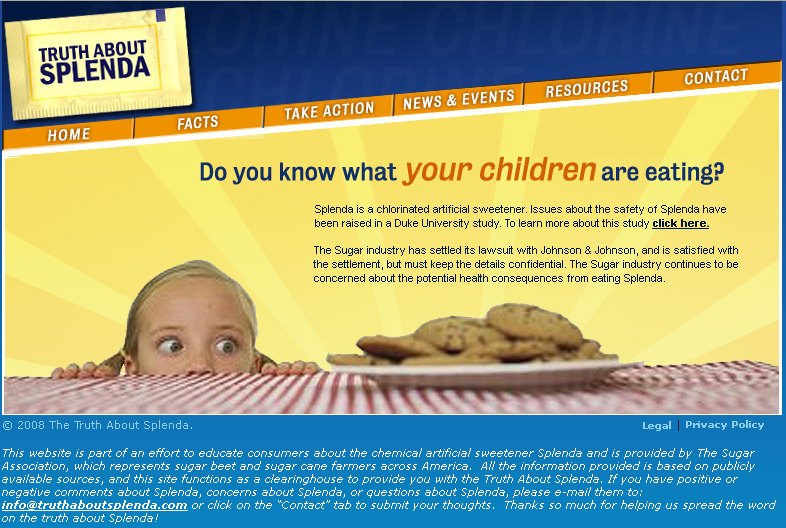
warning us about the "potential dangers" of Splenda ... well,
are you beginning to "smell a rat"?
Even the Dr's who have websites lambasting Splenda, sing exactly the same
tune. None of them
speak of the "potential benefits" of Splenda - ALL of them only speak of the
"potential dangers".
None of them have the guts to say Splenda DOES cause real harm, and none of
them compare it to
the widely used sweeteners, SUGAR & HFCS. Does this sound like they really
care about your health?
For 8 years while Splenda was sold and used in Canada, none of this
"bad press" existed. Then suddenly it's released in the USA and
The Sugar Association, which represents sugar beet and
sugar cane farmers across America launches a vicious campaign against
it! The above website is their latest attempt.
If they were really interested in your health, maybe hey should have warned you
about THEIR product - which does not have "potential dangers", but VERY REAL
DANGERS!
Truth is, they are worried about protecting their HUGE incomes from selling
their product to a SUGAR ADDICTED NATION ... that's what really is at stake
here.
Well, now it seems they are finally
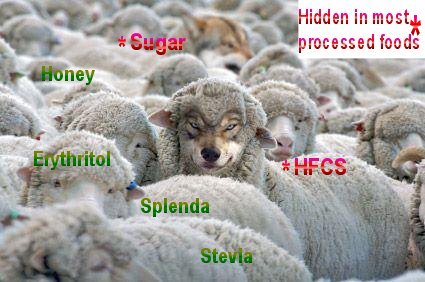
figuring out why the SUGAR MARKET is shrinking,
and it's NOT Splenda, Stevia
etc. that's responsible - it's HFCS from genetically modified CORN
But we have to "Trust them" with their "all natural product"? And distrust
Splenda?
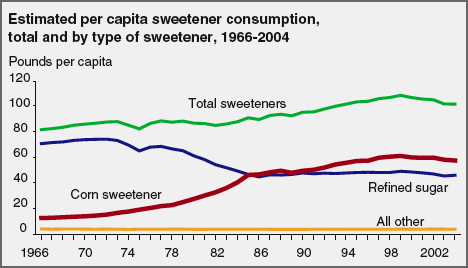
It's HFCS, the Corn by-products industry, that's "eating their lunch", and
the SUGAR industry has now filed a law-suite
against their "kissing-cousin"
(HFCS) to try and make themselves (SUGAR) look better. Now that's really Funny!
The Corn-processing-industry is feeling the heat BIG TIME, so they applied
to the FDA to change the name of HFCS
(in an attempt to fool us - yet again!) to "CORN SUGAR" from
High-Fructose Corn Syrup - and the FDA refused!
http://www.npr.org/blogs/thesalt/2012/05/30/154009682/fda-rules-corn-syrup-cant-change-its-name-to-corn-sugar
So, "Is Splenda® safe to use?" ... or rather,
almost 20 years later now,
"Was it safe to use?"
Well now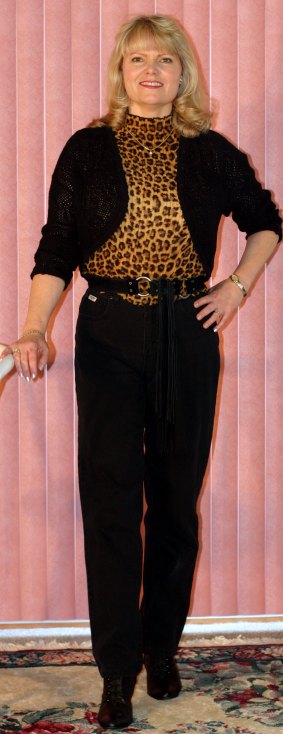 , this seems (again) to be a question on so many
people's minds nowadays
... Whether amongst my fellow low-carbers, by the many people coping
with diabetes, those working at controlling their weight or by people wanting
to eliminate or reduce the multitude of Sugars in modern diets. We (our
family) do have a rather unique perspective on this issue, and I'm sure one
you can relate to after reading this story, which I'm going to keep "chatty"
and informal, on purpose. You see, we have been the largest
personal users of Splenda on earth ... and we started doing so over 20 years
ago. I challenge anyone to find others who have had more Splenda than our
family in the last 20 years. Since we started 8 years before anybody in the
rest of the world (outside of Canada) and because of the many cookbooks I
developed, we did so on a massive scale - so that would be pretty much
impossible. Unlike many other people who try and scare you with theory, we can talk
from very personal experiences, so perhaps you may want to take the time to read
what life has been like for our family. I'm very leery of anybody that makes a
blanket statement about something being "bad" for EVERYONE ... and also of
anything being "good" for everyone, so that's not what I'm about to say
here. There will be people for whom Splenda etc. are just not good, for
whatever reason ... well then,
like with anything in life, simply don't use it. ALMOST anything we eat has
side-effects and consequences for somebody - some people die from foods
others view as perfectly healthy, so I guess the more important question is:
"Relative to SUGAR and HFCS,
how does Splenda fare?"
, this seems (again) to be a question on so many
people's minds nowadays
... Whether amongst my fellow low-carbers, by the many people coping
with diabetes, those working at controlling their weight or by people wanting
to eliminate or reduce the multitude of Sugars in modern diets. We (our
family) do have a rather unique perspective on this issue, and I'm sure one
you can relate to after reading this story, which I'm going to keep "chatty"
and informal, on purpose. You see, we have been the largest
personal users of Splenda on earth ... and we started doing so over 20 years
ago. I challenge anyone to find others who have had more Splenda than our
family in the last 20 years. Since we started 8 years before anybody in the
rest of the world (outside of Canada) and because of the many cookbooks I
developed, we did so on a massive scale - so that would be pretty much
impossible. Unlike many other people who try and scare you with theory, we can talk
from very personal experiences, so perhaps you may want to take the time to read
what life has been like for our family. I'm very leery of anybody that makes a
blanket statement about something being "bad" for EVERYONE ... and also of
anything being "good" for everyone, so that's not what I'm about to say
here. There will be people for whom Splenda etc. are just not good, for
whatever reason ... well then,
like with anything in life, simply don't use it. ALMOST anything we eat has
side-effects and consequences for somebody - some people die from foods
others view as perfectly healthy, so I guess the more important question is:
"Relative to SUGAR and HFCS,
how does Splenda fare?"
My name is Jennifer
Eloff, and as you may know, I write and sell Splenda-based
(SUGAR and HFCS FREE) Diabetes-control and
Low-Carb cookbooks. I was the first author in the world to do so and still am the
most prolific "Splendid author" ... BUT I was (and remain) a loving caring
mother and wife long before I was an author, and the last thing I would ever
do is to hurt our children or ourselves. I'm sure you would agree
with me that absolutely nothing is worth risking health, family and
happiness, and I'd rather never sell another cookbook if I thought for a
minute that our own family or someone else's was going to be hurt by doing
so. Life is just to short to have that on my conscience, and besides, we do
not need the money from sales of my cookbooks (Specialty cookbooks are not
very profitable anyhow) as the Good Lord has taken awesome care of us
through the years. Case in point ... I was inspired (the idea to do
all of this, was definitely "God-given" - and anybody who knew me as a young
girl would agree that it has to have been so) to REMOVE 2 products,
almost entirely out of our lives - SUGAR and HFCS ... and what a
blessing that has been! Admitting this may not be considered
"Politically correct" ... but it is "Correct"!
So, much more important than
first showing, BEYOND ANY SHADOW OF a DOUBT (What a luxury that would be for
anything we consume!) that Splenda was safe (for our family) to use -
upfront, over 20
years ago, was this CRUCIAL point:
REMOVING almost all Sugar and HFCS from our diets (over these last 20 years)
has been very beneficial to our health and weight (looks) and now there are
very credible medical and scientific studies that agree with me on this
issue. At 55, my only regret is that I did not do this much sooner!
ALL of the "warnings" and "scare-stories" about Splenda's
safety, hinge on the fact that the Sucralose molecule has Chlorine in it
(But many things do, such as SALT) and if this chlorine should break
loose, it can cause damage in our bodies and in the environment. Well, so
much for that argument - the SCIENTIFICALLY proven "good news" on this issue
is that it's virtually impossible for that to happen! The Splenda molecule
is stable, VERY long term, virtually indestructible by natural processes.
QUOTE: "scientists
have discovered that Sucralose is turning up in nature. This has them
worried and they've been concerned that the Chlorine component of Sucralose
will break down, separate and cause big trouble in the environment. Thing
is, they threw everything at Sucralose and could NOT break it down at all."
and "The resilience of Sucralose may be a good thing in some ways. The
researchers note that its resistance to degradation keeps it from breaking
down into highly toxic chlorinated compounds." ... This
is good news! It means it is totally inert, indestructible to heat and
useless to the body - so it passes safely through and into the environment,
where it remains unchanged, many years later, and it seems it is not doing any mischief
there either. You
can find more about these studies at:
http://low-carb-news.blogspot.com/2011/06/sucralosesplenda-inert-safe-and.html
By the way ... Before you think I'm
closed-minded, I have a new
book out (co-authored) that uses Splenda and/or Stevia and/or Erythritol:
See http://www.AmongFriends.us
And while Splenda is still my favorite sweetener,
I'm happy
enough with Stevia and Erythritol, and have used all of them, whenever
appropriate! They were not practical available options for me (20 years ago)
when I started writing cookbooks free of Sugar and HFCS ... BUT they are
now, and you can use any/all of them for my recipes in my cookbooks.
An Irony worth noting: My family moved from Canada (2006)
and we have all lived elsewhere (much further South) in South America, the
home of Stevia, since then. BUT we have to buy our Stevia from
the USA.
(Having endured 35 years of a mother
who makes "Jack Burns" ("Meet the Fockers") look like a real easy-going
Sweety, we finally ran away - we just disappeared. Canada was just not "big
enough" to hide from her)
 All that said, there is
so much hysteria on this subject (Most of which created by the "sugar lobby",
other selfish interests or by genuine - but often misguided zeal)
that by not at least presenting our case, we would seem to be conceding that
there really is a problem. Special interest are very hard at work to keep
sugars in almost every food we regularly consume and to reverse gains made by Splenda
in the market place. Just 100 years ago people each consumed much less
sugar. We now each consume more than 10 times as much as people did back
then, a half a lb per day (BUT that's the AVERAGE - so 50% of people consume more than that,
as we and many others in that statistic, consume almost none!) 100
Years ago, people did not have the major health
problems that we now, mostly, do. Type-2 diabetes was certainly not a teenage
epidemic, and obesity was rare - but then so were pop, candy and all the
processed foods with sugar added. Today those are immensely huge and
profitable industries! Let's see this issue for what it really is.
Sweeteners are a "red-herring" argument. We found that the elimination
of SUGAR and High-Frustose Syrup (on their own or in processed foods) was
what really helped us! Effectively, we used sweeteners to do this. One could
argue that (possibly) the sweeteners that helped us achieve that goal, have
side-effects, and some do. So was it worth it? Did the benefits outweigh the
side-effects? Here then is our simple story - which has been updated over 20
years now (by me and/or my DH). It still has some of the original text from
20 years ago, so please excuse it's "lack of literary style" and please make
allowances for my DH's, sometimes, bad grammar, he's not English by birth,
but his style is kind of cute, and he has added much of the new information
on scientific and medical knowledge etc. Anyhow, you can be
the judge ... weighing the believability of "theory and selfish
interests" - versus
that of "our simple practical experiences." The size of the
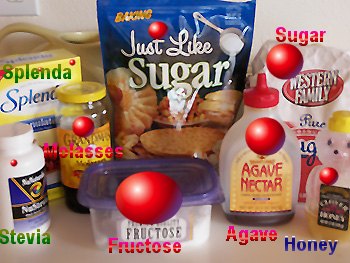
RED DOT on each product, simply indicates my degree of "leeriness" for the
product. Clearly there are only 3 of these I would definitely NOT use.
Whilst Honey has a lot of Fructose, it's flavor is so strong that one tends
to use a little, and it has other redeeming properties other than sweetness.
Agave is even higher fructose than HFCS. Sugar and HFCS are very similar,
Sugar being only slightly better, but Crystalline FRUCTOSE is bad. Molasses
has such a strong flavor that one tends to just add it to a recipes for
reasons other than sweetness, and so a little is fine. Stevia and Splenda
are really the best, along with Erythritol.
I've read worrying things about "chicory root", it is definitely NOT good to
use when pregnant as many sources seem to agree that it is has
emmenagogue (Brings on menses) and abortifacient (Can lead to an abortion)
effects. Also, though I have not been able to find definite proof, there
seems to be anecdotal evidence of it affecting vision. Still,
I have not used it - I just have not
felt the need to do so, so you will have to look into it.
All that said, there is
so much hysteria on this subject (Most of which created by the "sugar lobby",
other selfish interests or by genuine - but often misguided zeal)
that by not at least presenting our case, we would seem to be conceding that
there really is a problem. Special interest are very hard at work to keep
sugars in almost every food we regularly consume and to reverse gains made by Splenda
in the market place. Just 100 years ago people each consumed much less
sugar. We now each consume more than 10 times as much as people did back
then, a half a lb per day (BUT that's the AVERAGE - so 50% of people consume more than that,
as we and many others in that statistic, consume almost none!) 100
Years ago, people did not have the major health
problems that we now, mostly, do. Type-2 diabetes was certainly not a teenage
epidemic, and obesity was rare - but then so were pop, candy and all the
processed foods with sugar added. Today those are immensely huge and
profitable industries! Let's see this issue for what it really is.
Sweeteners are a "red-herring" argument. We found that the elimination
of SUGAR and High-Frustose Syrup (on their own or in processed foods) was
what really helped us! Effectively, we used sweeteners to do this. One could
argue that (possibly) the sweeteners that helped us achieve that goal, have
side-effects, and some do. So was it worth it? Did the benefits outweigh the
side-effects? Here then is our simple story - which has been updated over 20
years now (by me and/or my DH). It still has some of the original text from
20 years ago, so please excuse it's "lack of literary style" and please make
allowances for my DH's, sometimes, bad grammar, he's not English by birth,
but his style is kind of cute, and he has added much of the new information
on scientific and medical knowledge etc. Anyhow, you can be
the judge ... weighing the believability of "theory and selfish
interests" - versus
that of "our simple practical experiences." The size of the
RED DOT on each product, simply indicates my degree of "leeriness" for the
product. Clearly there are only 3 of these I would definitely NOT use.
Whilst Honey has a lot of Fructose, it's flavor is so strong that one tends
to use a little, and it has other redeeming properties other than sweetness.
Agave is even higher fructose than HFCS. Sugar and HFCS are very similar,
Sugar being only slightly better, but Crystalline FRUCTOSE is bad. Molasses
has such a strong flavor that one tends to just add it to a recipes for
reasons other than sweetness, and so a little is fine. Stevia and Splenda
are really the best, along with Erythritol.
I've read worrying things about "chicory root", it is definitely NOT good to
use when pregnant as many sources seem to agree that it is has
emmenagogue (Brings on menses) and abortifacient (Can lead to an abortion)
effects. Also, though I have not been able to find definite proof, there
seems to be anecdotal evidence of it affecting vision. Still,
I have not used it - I just have not
felt the need to do so, so you will have to look into it.
http://www.greenmedinfo.com/blog/cancer-feeds-fructose-america%E2%80%99s-1-source-calories
Here's a quote from our FaceBook page that really hilited this issue: "In
the last four months of my cancer, I was down to meats, fats and few green
vegetables, by the last month, nothing but meat and fat. My cancer simply
did not grow in four months, and it was squamous cell, a medium growing
cancer in the fourth
stage. There is no doubt in my mind that this diet is the reason I'm alive.
I'm cancer free now, and I'll never go back to eating this stuff. What
concerns me, is that people won't understand that that it's not an
"either/or" choice between HCFS and table sugar. If they understand that,
they try to figure out how to get mass amounts of honey or maple syrup in
their diets. There is little comprehension of the idea of living without
sugar, or that one becomes able to taste the sweetness of green vegetables
after a while, or that the sweetness of a few berries (fructose) can add a
lot of flavor. They're scared of artificial sweeteners more than HCFS or
table sugar."
http://www.alaskadispatch.com/article/studies-fault-corn-pesticides-american-honeybee-colony-collapse
So, not only are we eating foods laced with real (not imaginary) pesticides,
but the same HFCS we eat in (almost) every processed food, is killing off
BEEHIVES ...
you know, those hard working little gals that see to it that all our crops
and flowers can mature and reproduce! Smart hey?
And here's an intriguing article:
http://edition.cnn.com/2012/04/05/health/diabetes-drug-fights-cancer/index.html
(note HOW it fights cancer?)
And a great related article:
http://healthcorrelator.blogspot.com/2010/04/blood-glucose-control-before-age-55-may.html
and one more ...
http://dietheartpublishing.com/diet-heart-timeline (Seems this has been
known for a long time!) Clearly a case of "Marketing (and other BS)
baffles brains!"
SUGAR and HFCS are "kissing cousins", BOTH are BAD for us at levels over
15g/day (which is very little = 3 teaspoons)
http://www.facebook.com/photo.php?fbid=407299575961239&set=a.291353690889162.73895.288234024534462&type=1&theater
SUGAR and HFCS are commonly hidden in most foods we eat, so read the
labels!
http://www.facebook.com/photo.php?fbid=406850876006109&set=a.291353690889162.73895.288234024534462&type=1&theater
By now, you should begin to get my point: "Almost any artificial
sweetener - if used to ELIMINATE SUGAR and HFCS, is healthier for us!"
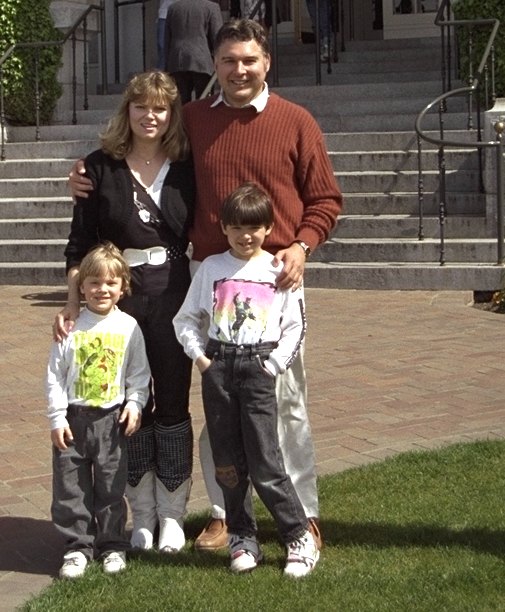 (Our
Family back then - April
1992) While it's true that Sucralose was tested over
many years, and that there have been both human and animal trials with Sucralose, I suspect
that the human trials must have been very controlled and likely did not represent
an extreme case of Sucralose consumption and that the animal trials
(probably using rats)
did probably include extremely large amounts of Sucralose. Now I don't know about
you, but I just cannot relate my health to that of rats! So then, is there a
actual case of comparably "extreme human Sucralose consumption"? Yes, in fact there is! In
fact ,to the best of my knowledge, there is only 1 such case in the world
... and I know them personally; you see, it is our family. Since 1991, when I
became the first cookbook author in the world to start developing Splenda-based dessert
(and other) recipes for my books, our family has consumed (on average) some 2,000 or
more cups
of Splenda annually, between the 4 of us, starting in 1991 when we were 35,
34, 7 and 4. My first book was published in 1993, my second book in 1997,
my third book in 2001, my fourth in October 2002, my fifth in October 2003,
my sixth in April 2004 and the seventh book is due out in October 2004.
The development and perfection of hundreds upon hundreds of dessert recipes
required the use of a lot of Splenda! A point that should not be
under-emphasized, is that an entire country, Canada, was using Splenda from
about 1991 ... that is some 8 years before it was available for use in the USA and
more than a
decade before it was available in many other countries, and all that time doing so without
much fuss or bother at all. In fact, Canadians have been using Splenda in a
variety of forms long before most people (around the world) even knew it
existed. So imagine all of our collective surprise when a decade later
some folks started portraying Splenda as being a "new" sweetener and intimating
(but never having the courage to categorically state) that it is a hazardous
substance as well? Well, for years now this article has been on the first page
when GOOGLE is used to search words "Splenda Safety". Generally ahead of us, and other useful Splenda
sites, have been the sites of "the Sucralose toxicity center" and of
several "health-care" persons who clearly just want to use the issue to garner
attention for their practices. Their veiled allegations have spawned other sites who
gladly took up
their banner and charged forth, for a variety of reasons. Most of these are
are somehow connected to Holistic healing type sites or the beleaguered
competition (Sugar industry etc) most of whom often take a very
non-professional (negative and sensationalist) approach when talking about Splenda's
safety (as well as other things). Very clearly they have a hidden (or perhaps not
so well hidden?) agenda. Personally, I am a little "miffed" at their very sneaky
self-serving approach, so much so that I am sharing a bit of my family's
history with you to put things into perspective. Some may immediately try and
hang that same allegation around my neck, but they'd be wrong. I do have actual
practical experience (which a lot of the critics do not!) on this issue, and I do
have a very valid reason for thinking that it's worth sharing.
(Our
Family back then - April
1992) While it's true that Sucralose was tested over
many years, and that there have been both human and animal trials with Sucralose, I suspect
that the human trials must have been very controlled and likely did not represent
an extreme case of Sucralose consumption and that the animal trials
(probably using rats)
did probably include extremely large amounts of Sucralose. Now I don't know about
you, but I just cannot relate my health to that of rats! So then, is there a
actual case of comparably "extreme human Sucralose consumption"? Yes, in fact there is! In
fact ,to the best of my knowledge, there is only 1 such case in the world
... and I know them personally; you see, it is our family. Since 1991, when I
became the first cookbook author in the world to start developing Splenda-based dessert
(and other) recipes for my books, our family has consumed (on average) some 2,000 or
more cups
of Splenda annually, between the 4 of us, starting in 1991 when we were 35,
34, 7 and 4. My first book was published in 1993, my second book in 1997,
my third book in 2001, my fourth in October 2002, my fifth in October 2003,
my sixth in April 2004 and the seventh book is due out in October 2004.
The development and perfection of hundreds upon hundreds of dessert recipes
required the use of a lot of Splenda! A point that should not be
under-emphasized, is that an entire country, Canada, was using Splenda from
about 1991 ... that is some 8 years before it was available for use in the USA and
more than a
decade before it was available in many other countries, and all that time doing so without
much fuss or bother at all. In fact, Canadians have been using Splenda in a
variety of forms long before most people (around the world) even knew it
existed. So imagine all of our collective surprise when a decade later
some folks started portraying Splenda as being a "new" sweetener and intimating
(but never having the courage to categorically state) that it is a hazardous
substance as well? Well, for years now this article has been on the first page
when GOOGLE is used to search words "Splenda Safety". Generally ahead of us, and other useful Splenda
sites, have been the sites of "the Sucralose toxicity center" and of
several "health-care" persons who clearly just want to use the issue to garner
attention for their practices. Their veiled allegations have spawned other sites who
gladly took up
their banner and charged forth, for a variety of reasons. Most of these are
are somehow connected to Holistic healing type sites or the beleaguered
competition (Sugar industry etc) most of whom often take a very
non-professional (negative and sensationalist) approach when talking about Splenda's
safety (as well as other things). Very clearly they have a hidden (or perhaps not
so well hidden?) agenda. Personally, I am a little "miffed" at their very sneaky
self-serving approach, so much so that I am sharing a bit of my family's
history with you to put things into perspective. Some may immediately try and
hang that same allegation around my neck, but they'd be wrong. I do have actual
practical experience (which a lot of the critics do not!) on this issue, and I do
have a very valid reason for thinking that it's worth sharing.
BACKGROUND: It does not often happen
this way, but us 35 million humble, gentle, peace-loving, quiet folks
(Canadians) that
live to the north of the
mightiest nation on earth - the one that rules the world, the United States of
America, actually can talk quite
authoritatively on the subject of Splenda's safety, it's strengths and it's weaknesses,
and do so much more helpfully than, say, Dr. Mercola (Who does some fabulous
work at times) and these other sites! Years ago,
rather perplexed, we e-mailed Dr. Mercola
to point out our family's positive Splenda story, but it seems he was way more
interested in only pointing out the very few poorly documented (and
scientifically suspect) negative stories
(all heavily laced with innuendos) and he never
even bothered to reply to us, so really, since these sites just mention the
negatives, I'd have to conclude that they are really not interested in any
balanced scientific approach at all. What's more, in one of the videos on his
site, he states that we'd be better off having SUGAR (or HFCS) than an
artificial sweetener like Splenda. Now really - in light of the overwhelming
scientific evidence on the safety of SUGAR and HFCS, I'd respectfully
suggest he should seriously consider saying: "OOPS ... I take that back!"
Well everyone is allowed their "foibles", and an otherwise good Dr. with plenty
of helpful advice, does himself (and us) no service by still rallying against a
20 year market-place tested product that is clearly very much better for us than
SUGAR and HFCS. At least for our family's health, it's been a huge positive!
Remember, everyone's different, so you will have to figure out what works for
you, and what does not. This is just my opinion ... based on substantial
practical experience with Splenda.
All of the negative information on Splenda
is traceable back to a few people/groups and they then simply point back to
each other as "authorities" to back up their claims - not very scientific or
even helpful at all but often effective at scaring people. Anyhow, as I update
this article, some 20 years after Splenda
first appeared on our store shelves here in Canada, my husband and I are
soon
turning 56 and 55, and our sons are
turning 25 and 28. To be totally safe I suppose we could
all wait another 30 years or so, then after 5 decades we will all know more definitively if Splenda has harmed us
and/or others in any way. BUT, until then, this is how we reasoned, when deciding to integrate Splenda (Sucralose) into our
family's diet:
Back in 1991, we were ASSURED
(by the USA
manufacturers of Splenda) that:
(1) Sucralose is Chemically Inert and does not react with anything while in
your body - This was/would have been tough for us to
verify, but 20 years later it seems to be so.
(2) All the Sucralose ingested is excreted (un-metabolized) from your body -
Once again, it would have been tricky for us to verify,
but some studies (see:
http://low-carb-news.blogspot.com/2011/06/sucralosesplenda-inert-safe-and.html
) now seem to suggest it is so.
(3) Sucralose has no calorific content and cannot be used as an energy source
- True, but it is interesting to note that Splenda does indeed contain
calories, due to the addition of the fillers, maltodextrine and dextrose, giving
Splenda 1/8th the calories of Sugar - higher than some other sweeteners, but still way better than sugar!
(4) Sucralose is very stable, even intense cooking/baking heat will not change
it - This does indeed seem to be the case.
(5) Sucralose tastes very much like Sugar (Sucrose) and has no strange aftertaste
- Well ... it is certainly the best tasting of the sweeteners we have tested.
(6) Sucralose has been approved for a very wide range of uses by the FDA and
other countries - The FDA and other countries' Health departments/agencies
(Health Canada being the first) did indeed approve it. OK, today I'd worry a lot
more about "FDA APPROVAL" than I did back then, as I'm not so trusting of them
anymore, but at least it's worth noting that it was FDA approved after 11 years
of studying it, fully
8 years after Canada approved it.
(7) Sucralose has been subjected to many tests over many years in many countries
- Yes, but before it was released, it was not tested in huge amounts on people of both sexes and of all ages
and over a long period of time afterwards. In effect, we Canadians became those test subjects. So
then, you may ask us, how did Splenda fare?
Our Family in 2003:
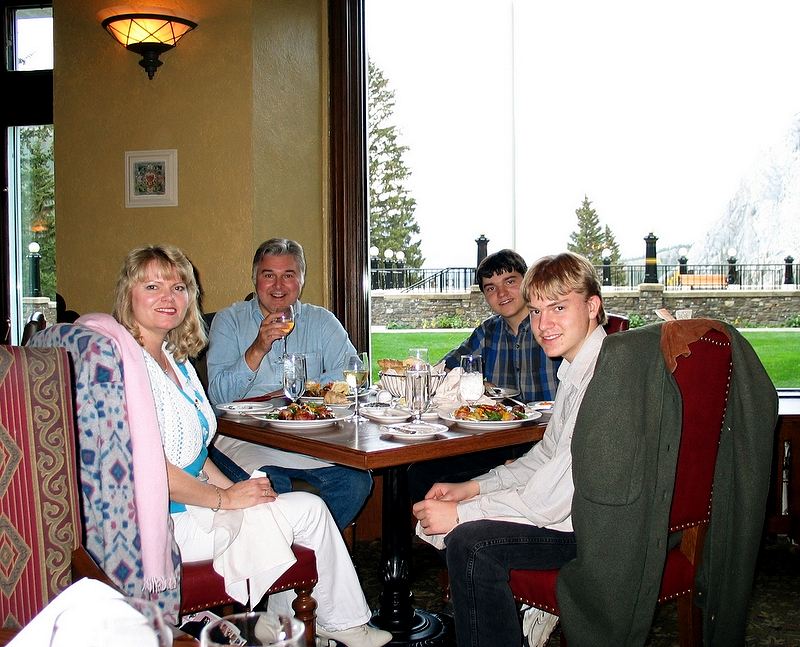
(And in 2004) So, what if anything (health-wise) went wrong with our
family during the first dozen or so years? With the benefit of hind-sight, probably around
1995 or so, I developed Hashimoto's Thyroiditis, a fairly common autoimmune
condition, especially in women in their mid-life, that affects the thyroid.
However, this went undiagnosed (as is often the case) until 2002. Since this
condition is "acquired" by women, the world over and most of them have never
even heard of or
used Splenda, I doubt very much that Splenda was to blame for me getting it..
However, this condition made me "hypothyroid", which meant that losing weight
(an ongoing struggle for most of my adult life) got to be almost impossible, and
using Splenda to help me in that regard, took on a whole new meaning! I have
fluctuated from my marriage weight (at 22 years of age) of 110lbs to as much as 150lbs, which on my
5'3" frame was quite noticeable! I regard my ideal weight now to be around 120lbs,
though this has been a rather elusive goal for me with the mid to low 130's being
where I have spent most of my last 9 years. Developing cookbooks (continuously)
is, by it's very nature, quite calorific! I would hasten to add that if I were
not developing low-carb recipes, I undoubtedly would be well above 150lbs,
however, I'm in the low 130's.
Every now and then I manage to push my weight down into the 120's, but having a
"problematic thyroid" makes that quite a challenge! I started seriously
investigating Low-Carbing back in the late 1990's, and by late 1998 my husband
and I started to low-carb. In the last few years, my husband went on to have
some struggles with mild hypertension which now is under control, but this
runs in his family and probably has more to do with his weight (at times, like
on world travels, he cheats) and a higher salt consumption than what is wise, as well as his "driven" nature and
his stress-filled career and life - his in-laws (sadly) having been a major
contributor to that stress. Other than that, our dental health is great,
our weight is (almost) under control. We all have suffered from blessedly few
viral/bacterial infections, since almost entirely eliminating sugar from our
lives, and even fewer after adopting the low-carbing way of life. Overall I'd have to say that our general health
and sense of well-being is excellent. As we did for our own family, you must research the topic well
and decide whether to include Splenda (Sucralose) in your own diet or the diet of
your family. For us now, there is no turning back - we are committed, long
time users of Splenda. Time will tell if that was a wise or an unwise choice. We simply
decided that our family's "Sweet-tooth" could not be removed, but that Sugar was
certainly not making us any healthier! That was our family dilemma in
1991/92.
 Back then we evaluated the alternatives and chose to integrate Splenda into our Diet ... at
least until something better came along. Nothing has ... as of yet. Above (and
below) are recent
photos of us all, taken when our eldest son turned 20, in early June 2004. They
show all of us, with our eldest son 20, our youngest 17, me 47 and Ian 48 ...
still happy and healthy and, though we need to get serious again about "those
last 10 lbs or so", not looking at all out of control as Ian and I approach 50,
having (just this month) celebrated our 25th wedding anniversary. We are childhood sweethearts
and have known and loved each other for 34 years, this Christmas. Obviously we
care about each other and our children and would not do anything to jeopardize
each other or our children. Our son's routinely achieve 90% and higher in
all their academic achievements, are tall, healthy, have great physiques,
pleasant personalities and are a credit to society! We have noted NONE of the
supposed symptoms on the list in several Dr's anti-Splenda websites. How
odd? After all, we all have consumed much more Splenda than any of the people he
quotes as having terrible problems. How odd too that so many people now
routinely use this product, including much of Canada for almost 14 years
(make that 20 years in 2012), with no symptoms, yet
they try to make one believe
that terribly dire consequences will result from using even a little Splenda ...
and then quickly go on to suggest you buy their books in which the tell you how
to remove all and any sweetness in your life too - to be just like them. Hmm ...
sounds somewhat "fishy"! It is not entirely impossible that some very few people
exhibit adverse reactions from consuming Splenda, though I have never come
across or heard of any in the years before Splenda was released in the USA. But what
these anti-Splenda folks neglect to
mention (to place even that information in perspective - and I feel they should, as
a professionals) is that many people almost die from eating shrimp,
strawberries, eggs and nuts etc. (all natural products - even if they are
organically grown) and that the numbers of those "adverse reactions" clearly are
very much higher than any of the so-called adverse reactions they report on their websites.
Back then we evaluated the alternatives and chose to integrate Splenda into our Diet ... at
least until something better came along. Nothing has ... as of yet. Above (and
below) are recent
photos of us all, taken when our eldest son turned 20, in early June 2004. They
show all of us, with our eldest son 20, our youngest 17, me 47 and Ian 48 ...
still happy and healthy and, though we need to get serious again about "those
last 10 lbs or so", not looking at all out of control as Ian and I approach 50,
having (just this month) celebrated our 25th wedding anniversary. We are childhood sweethearts
and have known and loved each other for 34 years, this Christmas. Obviously we
care about each other and our children and would not do anything to jeopardize
each other or our children. Our son's routinely achieve 90% and higher in
all their academic achievements, are tall, healthy, have great physiques,
pleasant personalities and are a credit to society! We have noted NONE of the
supposed symptoms on the list in several Dr's anti-Splenda websites. How
odd? After all, we all have consumed much more Splenda than any of the people he
quotes as having terrible problems. How odd too that so many people now
routinely use this product, including much of Canada for almost 14 years
(make that 20 years in 2012), with no symptoms, yet
they try to make one believe
that terribly dire consequences will result from using even a little Splenda ...
and then quickly go on to suggest you buy their books in which the tell you how
to remove all and any sweetness in your life too - to be just like them. Hmm ...
sounds somewhat "fishy"! It is not entirely impossible that some very few people
exhibit adverse reactions from consuming Splenda, though I have never come
across or heard of any in the years before Splenda was released in the USA. But what
these anti-Splenda folks neglect to
mention (to place even that information in perspective - and I feel they should, as
a professionals) is that many people almost die from eating shrimp,
strawberries, eggs and nuts etc. (all natural products - even if they are
organically grown) and that the numbers of those "adverse reactions" clearly are
very much higher than any of the so-called adverse reactions they report on their websites.
Addressing the inevitable "scare stories" out
there ...
So, before you get "traumatized" by the inevitable
"scare-mongers" out there on the web, just stop and think logically for a while ...
While they desperately try and make you believe that Splenda is relatively new
and has only been available for 5 -10 years, that is just not true! Canada is an entire
country in which MILLIONS of people have been regularly using Splenda for
almost 20 years now. It has a National (Government run) Health care system, for which
Federal and Provincial (State) dollars pay. So what exactly would be the incentive for
Health Canada (our FDA) to approve Splenda and keep it approved, if it was
costing these governments Billions of $'s in ongoing health care costs? Thus the
thinly-veiled allegations that somehow these international "Health agencies", like
Health-Canada and others, do not know what they are doing or are somehow "in the pocket" of Johnson & Johnson (the parent
company) or Tate and Lyle (the manufacturer) so that they can make (in Canada)
some 10's of Millions of $'s in profits each year (which is mostly sent down to
the USA parent company anyway), while we
here in Canada get stuck with a Billion $ health-care bill (for which we all
have to pay, as a result of an "unsafe product") is just plain ludicrous! I have
no doubt that our Health Department (which is totally independent of the FDA)
knew exactly what it was doing when Canada became the first country to approve Splenda
for Human consumption back in the early 90's - some 8 years before the FDA
approved it for consumption in the USA. Canadians have all been using Splenda
for almost 20
years now, and there really have been no problems of any significance reported here. Still, just remember that
there are no "iron-clad" guarantees" in life. Not consuming any food or drink
will probably protect you from harmful substances, but then you'd be dead within
2-3 days from thirst anyway - however consuming just gasoline will kill you much
quicker. Somewhere in the middle of those two extremes lies "reason" ... and
that's a really good place to live! Ian's Dad, as a young boy, was pretty much
already "given up for dead" from a massive bacterial infection (in the late
1920's) and lay dying in a remote part of the world (at the southern tip of
Africa) when their family Doctor (at that time) suggested that "Sulfur drugs",
the first antibiotics, just newly available in Germany, had been noted to cure
that particular infection. These man-made (not natural!) Sulfur drugs were then
flown from Germany to South Africa, in the antique planes of those days, and
were successfully used to save his life. He went on to become a Doctor in
the remotest regions of Southern Africa, in turn saving many people from dying
from Typhus and other deadly diseases. The family in the picture (above) would
not exist today were it not for man-made substances. Let's get real
... to take a "hard and fast" stance against everything "not natural" is also
just plain dumb! Let's not forget that our own bodies produce
Chlorinated-Hydrogen (HCl) in significant quantities and then pumps this very
strong hydrochloric acid directly into our stomachs on a regular basis all
of our lives, and has done so with humanity as far back as we can be traced.
That acid, as it is produced by our bodies, is highly corrosive! As well,
Chlorinated Sodium (NaCl) otherwise known as table-salt, is pretty useful stuff,
so the "Chlorine bogeyman", though effective for scaring people, can also be
very misleading! Yes, there are many dangerous natural and man-made substances, and
there are many good natural and man-made substances ... so let's use "reason" to find
the good ones, and "reason" to avoid the bad ones, but very importantly, let's
try and avoid "hysteria" for determining either - that really serves nobody
well at all!
The future ...
 Rest assured, if we notice ANY problems possibly relating to our massive Splenda
consumption, we will let you know - right here on this web-site after doing
some due-diligence. For now, ponder this: The average person (in North America)
consumes about 170 lbs of Sugar a year (that is around 380 cups) compared with
about 10 lbs a century ago, and displays a wide variety of side-effects from
this over consumption of Sugar! In my family, for more than a decade now, we
have almost eliminated the consumption of Sugar and each of us has consumed
much more than that (some 500 cups annually) of Splenda instead of Sugar.
On this website, there is a story of my "Thyroid problems".
While it is remotely possible that these can somehow be related to my massive Splenda consumption, I personally doubt it. None of my family members seem to
be showing
any similar problems and thyroid problems have a natural tendency to occur (quite
frequently) in women of my age, most of whom have never used any Splenda.
Rest assured, if we notice ANY problems possibly relating to our massive Splenda
consumption, we will let you know - right here on this web-site after doing
some due-diligence. For now, ponder this: The average person (in North America)
consumes about 170 lbs of Sugar a year (that is around 380 cups) compared with
about 10 lbs a century ago, and displays a wide variety of side-effects from
this over consumption of Sugar! In my family, for more than a decade now, we
have almost eliminated the consumption of Sugar and each of us has consumed
much more than that (some 500 cups annually) of Splenda instead of Sugar.
On this website, there is a story of my "Thyroid problems".
While it is remotely possible that these can somehow be related to my massive Splenda consumption, I personally doubt it. None of my family members seem to
be showing
any similar problems and thyroid problems have a natural tendency to occur (quite
frequently) in women of my age, most of whom have never used any Splenda.
So, for now you can regard Canadians as "Human test subjects" (notice
that
I did not say "test-dummies") for Splenda
consumption. If anything does go wrong with any of the members of our
family, we will detail it on
this website, as we have done above, openly and honestly, and
then we can all debate, openly and honestly, whether we/you think Splenda (reasonably) may have had anything to do with it. Remember, we have
almost a decade-long head start on most of you in the massive consumption of Splenda
(Sucralose) and, without a doubt, as far as people are concerned, we have been the largest users of Splenda
on this planet! We likely have each consumed more Splenda (Sucralose) in
almost 20 years, than most people will consume in their entire lifetimes. Our
family and children have
grown up on Splenda and we are all still alive, well, happy, in love
... and generally thriving. Worth mentioning is that by almost eliminating Sugar
consumption in our family, we have indeed noticed improved health! However, it
can be argued (with some merit) that if we eliminated
Sugar and never used Splenda, we would likely be even healthier? Yes, perhaps, but one
has to enjoy life too, and tasty sweet treats have been and continue to be an
important part of
all of our lives!
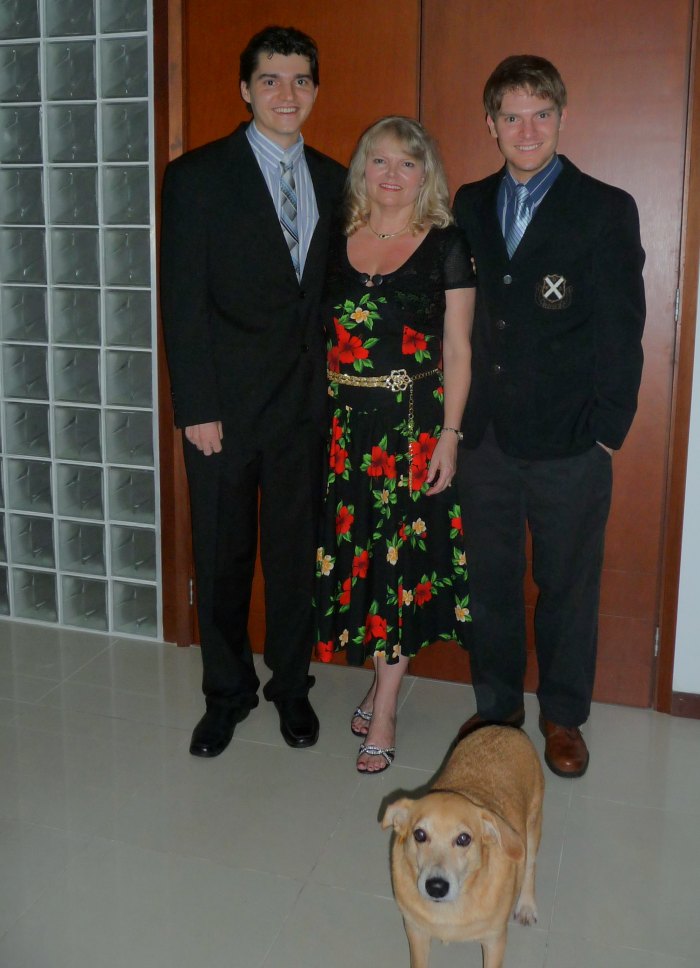 {2011,
Jen and her sons } Also, there has been a lot of "speculation" that
artificial sweeteners actually make us gain weight
by making us want carbs even more - well clearly
that's not true. All the innuendos and speculation
about most of the artificial sweeteners, is really
just a "Smoke Screen" to protect the really guilty -
SUGAR and HFCS, which do so much real harm to our
bodies over time.
{2011,
Jen and her sons } Also, there has been a lot of "speculation" that
artificial sweeteners actually make us gain weight
by making us want carbs even more - well clearly
that's not true. All the innuendos and speculation
about most of the artificial sweeteners, is really
just a "Smoke Screen" to protect the really guilty -
SUGAR and HFCS, which do so much real harm to our
bodies over time.
With that in mind, take a look at:
http://au.news.yahoo.com/sunday-night/video
and
http://www.medicalnewstoday.com/articles/242328.php
and
http://low-carb-news.blogspot.com/2011/11/go-to-dr-eenfelds-blog-and-listen-to.html
Now for some common observations about Splenda
and other sweeteners:
Sucralose is made from Sugar and is used to make Splenda which tastes like
sugar. Sucralose, has no calories but also does not measure, look or act much
like sugar. Sucralose is 600 x sweeter than sugar, so much less is needed for
the same sweetness. To make it appear as a replacement for sugar, Sucralose is
bulked up with Maltodextrin a carbohydrate derived from corn, giving it some
calories but making it measure and act more like sugar. This combination is
called Splenda Granular. Splenda Granular weighs 1/8 as much as sugar, has 1/8th the
calories but lacks the volume sugar imparts to recipes, does not caramelize, is
very tricky to use for chocolate recipes of all kinds, is even trickier to use
for candy making, has a definite "lag" in it's sweetness and is generally not as
easy to use as sugar in baking, which is exactly why I
did much experimenting and wrote these Splenda-based cookbooks, to show how
these flaws can be compensated for. For any recipes in which sugar
contributes greatly to the structure and volume (which accounts for many
desserts), it is not possible to simply substitute Splenda, and expect to still
get a similar result. You need to make substantial modifications to the other
ingredients in the recipe. These modifications are essential in order to end up
with a dessert similar to the sugar-based original. This problem is not as
prevalent in meat/vegetable dishes which use less sugar and in which the Sugar
is simply used to "sweeten" the dish. Baking, Desserts and Candy is where the
major challenges lie. Splenda Granular
contains 100 calories per cup, whereas sugar contains 800 calories. Splenda is
the 'marketing' or 'brand' name. Sucralose is its chemical name and it has ZERO
Carbs and calories. Splenda is
supposedly chemically inert and we are told that all the Sucralose one consumes
is excreted unused. The Maltodextrin (starch used to bulk-up the Splenda) is, of
course, recognized by the body as a 'weak'
carbohydrate (actually it has a high glyceamic index, but because there is
relatively little of it, by weight, present in a cup of Splenda it adds
relatively few carbs/calories) and is treated as such by the body - thus the Carbs/Calories
in Splenda. Splenda is heat stable at
baking temperatures (like sugar and unlike Aspartame). Splenda is approved for
use in the USA (1998), Canada (1991) and many other countries now. Splenda has
been subjected to rigorous tests over a 20 year period and is generally deemed
"safe". Splenda was discovered by the giant UK sugar company Tate and Lyle in
the 70's. Splenda is marketed by a Johnson and Johnson subsidiary, the McNeil
Specialty Products company. Splenda has been used in large amounts by my family
for some 20 years now. Each member of my family has
consumed thousands of cups of Splenda over that period, with no obviously
apparent ill effects?. Splenda is certainly worth investigating as a sugar
substitute! It is definitely a cut above other artificial sweeteners
- but it is not perfect! Splenda Granular is what I use preferentially
and occasionally I will use some (few) sugar free chocolate chips sweetened with a sugar
alcohol (usually maltitol). I
prefer not to use Sugar, but one can add some sugar into bread recipes, and
others using yeast in the rising process, as the yeast consumes the sugar. I absolutely refuse to use Aspartame/Nutrasweet/Equal,
Saccharin, Cyclamates or Sorbitol - even though they are cheaper. Splenda does
not cause abdominal discomfort or tooth decay. Maltitol has some potential for
some low-carbers, however, you may as well count it as having half the total number of carbs
of sugar, just to be on
the safe side. The problem is that most of the sugar alcohols (Those ending in "ol"),
either cause various degrees of gastric distress (you may as well buy and eat
Ex-lax rather than buying a Sorbitol sweetened chocolate candy) or others have a
cooling effect on your mouth (kind of like menthol) and are not really "ZERO
CARB" options, besides being expensive and sometimes hard to find! Acesulfame-K and Stevioside are
somewhat interesting, but simply because Stevia occurs naturally (exactly the
same can be said about SUGAR, by the way) simply does not guarantee that it is safe.
Because the word "natural" can legitimately be applied to Stevia, it has big following - but that does not mean that it is definitively "Safe"
- or even that it is
"safer" than Splenda. Stevia proponents have yet to prove their claims
scientifically beyond any reasonable doubt, though they do have lots of
anecdotal evidence and it does not appear that any "smoking-gun" has been found
yet, but really, the "taste-test" is what ruled it out for me - it's taste (in
its various forms) leaves a lot to be desired!
So whilst Acesulfame-K and Stevioside are
somewhat interesting, I tend towards preferring Stevia, since even
though Acesulfame-K has received
GRAS approval by the FDA, I'm really not quite happy with it either, and there
does seem to be credible links to it being a carcinogen under certain
circumstances? As for Stevia, it really seems like a good choice, but I have to add a word of reason here that is often missing from
discussions of natural products. Just because Stevia occurs naturally (exactly the
same can be said about SUGAR, by the way) simply does not guarantee that it is safe
and that I or anyone else can give it an automatic "stamp of approval",
although all the known evidence does seem to support it's safety. [Next few
sentences are "historical"] The FDA did not classify STEVIA as "Generally regarded as safe" (GRAS)
substance until late 2008.
Because the word "natural" can legitimately be applied to Stevia, it has
quite big following, and has a potentially HUGE following if some large company
would actually do the right things with it - but that does not mean that it is definitively "Safe", or even, for that matter, that it is "safer" than
SPLENDA® Low-Calorie Sweetener, as GRAS classification does not require testing.
Personally, I have to think
it probably is just fine. However, really, it was the "taste-test"
that made me leery about it - it's taste (in its various forms) certainly
leaves (no pun intended) a lot to be desired! It has been a "bitter-sweet"
experience, but these are early days and refining Stevia as well as various
blends (generally with
Erythritol)
are changing that fast. {DATED INFO - till 2008 follows} For the longest
time Stevia was not
approved by the FDA for general use as a sweetener, and thus I could
not
promote its use in my cookbooks or on this website, as that could lead to
seizure of my books at the border by US customs as you can read in the
unbelievably draconian story:
http://www.apfn.org/THEWINDS/1998/07/stevia.html which really conjured up
images of book-burnings in Nazi Germany, for me, so "TRUST the FDA", I do not! {UPDATED INFO} Friday
Dec 19, 2008 -- The FDA sent a fax to Cargill Inc and Merisant Co's Whole
Earth Sweetener unit on Dec 17 saying that the agency has no objection to the
petitioners' claim that Stevia is generally recognized as safe sweetener.
Rebaudioside A (rebiana) derived from stevia leaves, is marketed by Cargill and
Marisant Co. and finds applications in new low-sugar beverages being developed
by Coke-Cola Co. and PepsiCo Inc. According to the Institute of Food
Technologist, an organization representing tens of thousands of food
technologists and food and beverage companies, the GRAS status clears the way
for the biggest beverage companies to launch their planned low-sugar beverages
with this sweetener. Funny how the FDA suddenly changes it's "draconian tune"
when a HUGE company like Cargill says "Hey FDA, Stevia is OK - get it?" However, before rushing ahead to use the many new Stevia
based sweeteners, please read:
http://low-carb-news.blogspot.com/2009/10/possible-stevia-side-effect.html While
Stevia has a profile that would suggest it's indeed AOK, there are some things
we need to understand about it. What's intriguing to me, is to see the makers of SPLENDA® Low-Calorie Sweetener
releasing their own Stevia based sweetener, see:
https://www.suncrystals.com/products/granulated/nutritional-information/
<--- This link is now "dead" (Update 8-March 2012)
Sun crystals have been discontinued, due to unmet sales expectations,
but they still seem to be available from some places. Personally, I'm not sure
what they were thinking ... combining Stevia and Sugar,
kind of like being half pregnant and half not ... problem is, you never have the
baby! Neither, it seems, did they. They also have products which combine Splenda
with SUGAR ... speak about "mixed up!" In a day and age when research is clearly
showing SUGAR is a major health problem, what next can we expect from these
marketing geniuses? Maybe Splenda + HFCS blends? At least with Stevia they
added
Erythritol, not Sugar! Well,
let's just "stay tuned" to see how Stevia
progresses, it definitely has merit as a sweetener, but my own testing has not
convinced me or my family to switch completely to it - yet. The product needs improvement,
and manufacturers real need to get real on pricing ... but then again, as
I said, it's still,
relatively speaking, "early days" for Stevia as a commercially
available product.
The most balanced news article/study about sweeteners (to date) that I've found,
is:
http://www.latimes.com/news/science/la-he-sweetner19nov1907,0,2825074.story?page=1
and it has updates as well.
 Here's what's MUCH worse for you than any of
the artificial sweeteners:
Here's what's MUCH worse for you than any of
the artificial sweeteners:
-
In 1700, the average person consumed about 4 pounds of sugar per year.
-
In 1800, the average person consumed about 18 pounds of sugar per year.
-
In 1900, individual consumption had risen to 90 pounds of sugar per year.
-
In 2009, more than 50 percent of all Americans consume one-half pound of
sugar PER DAY—translating to a whopping 180 pounds of sugar per year!
-
In 1893, there were fewer than 3 cases of diabetes per 100,000 people in the
United States. Today, diabetes strikes almost 8,000 out of every 100,000
people
-
Now
the average American consumes 888 calories per day from sweeteners,
according to the USDA. We think their numbers are low, that it's actually
More 1,000 Calories per day.
-
In 1890 a mere 3.4 percent of Americans were obese.
-
By 1975, the obesity rate in America had reached 15 percent, and artificial
sweeteners were just not an issue in those 85 years, BUT SUGAR and HFCS use
underwent explosive growth, going from some 15lbs/year to 120lbs/year (x 10
"ten times!")
-
Now 32 percent of Americans are obese and an additional 30% are overweight,
and we each consume about 180lbs/year of SUGAR and HFCS.
And the SUGAR industry and High Fructose Corn Syrup industry
has very cleverly and successfully got all of fighting amongst ourselves about artificial
sweeteners ... to take the focus off of these facts (above) BUT (read on)
UPDATE:
This fight now has really Got very "funny"!
Now that the SUGAR industry is fighting with the High-Fructose
Corn-syrup industry:
http://www.latimes.com/news/local/la-me-sweetener-suit-20120307,0,7189463.story
- In court papers, the sugar industry says the nation's soaring
rise in obesity and diabetes has dovetailed with the penetration of the
synthesized corn sweetener in soft drinks, condiments, bread, cookies, jam and
syrups. The corn forces respond that there is nothing dishonest about their
advertising and that they will prove it in court. Just a little while back the
Sugar industry concentrated on fighting Splenda, but that was a diversionary
tactic. Now that the finger of blame is pointing squarely at the and the "corn
syrup" makers, they realize they are in much bigger trouble, and it's time to
try and distance their product from High-Fructose Corn Syrup! BUT as the
"60 minutes Expose"
points out, they are basically identical products!
Another one is:
[ Dr. Eades
examines the "Sugar lobby"
and their carefully crafted anti-Splenda shenanigans ]
Jonathan, 25, my youngest son, barely 5 when we started
using Splenda ... has a HUGE "sweet-tooth!"

Just imagine if he had consumed 500 cups of SUGAR & HFCS
(instead of the Splenda) for each of those 20 years ...
Jonathan's a Romance-novel author and will appear
(alongside me) in a section in Low-Carbing among
friends V-2 & 3.
He is a very principled young Christian man (a youth leader at church) still
looking for his "true love" (hasn't found her yet)
and is also now a publisher! Jon drives a classic GOLD Mercedes, is a
body-builder, fluent in Spanish and lives overlooking
the ocean in a beautiful, modern, South American city in the tropics,
where, as you can see, he is also a part-time model.
I wonder what Jon would have looked
like, by now, if he had consumed 500 cups of SUGAR & HFCS each year, for 20
years?
What would that have done to his health? According to the "60-minutes" (above)
on SUGAR and HFCS", the answers are NOT GOOD!
Maybe (to be fair) we should now ask
this question:
So, "Is
Sugar and HFCS safe to use?" ... or rather, almost 100 years later, "Were
they safe to use - in ever increasing large quantities?"
What would your answer be?
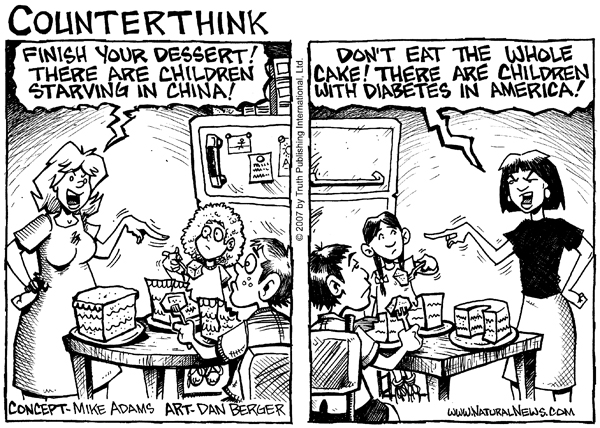

 "Those that laugh last ... laugh
best!"
"Those that laugh last ... laugh
best!"
By the way ... I have a new
book out that uses Splenda and/or Stevia and/or Erythritol:
See http://www.AmongFriends.us
While Splenda is still Jennifer's favorite sweetener, she's happy
enough with Stevia and Erythritol, and has used all of them
whenever appropriate.
Other Miscellaneous
stuff ....
If you tire easily of this "tempest in
a tea-pot" ... you may rather want to amuse yourself by taking a look at
the following links:
It can be argued that Jennifer,
now 55, who
grew up in Colonial AFRICA, has a past that is way more
intriguing
than
any of the cookbooks she has authored. Her son, Jonathan, has written a series of NOVELS based on her
unusual life-story:
[ Click here to go to
Jen's
"Low-Carb" website ]
[ Click here
to go to Jen's
"Low-Carb" BLOG ]
[ Click here to
order the "Splendid series" of cookbooks ]
[ Click here to go
to Jen's old (retro)
"Sweety" website ]
[
Click here to
read the fun story of Jen's "Sweetest date"
in a long time
...]
"The
proof has definitely been IN THE EATING
of the Pudding - and Cake and of most things sweet,
AS
LONG AS they were NOT sweetened with SUGAR or HFCS !
"
McNeil Specialty Products
Company has gone to a lot of trouble and expense to allay people's justified
fears concerning the safety of SPLENDA® Low-Calorie Sweetener low-Calorie
Sweetener, yet their expensive flashy website:
http://www.splendatruth.com/
often
ranks lower than Jen's websites when a GOOGLE search is done for "SPLENDA
SAFETY" - and all they had to do was say: "Go speak with Jennifer's family"
and most people would conclude that their families will never consume even
1/100th as much Splenda in a Lifetime as what we each have in 20 years, and
well, common sense would (least it "should") prevail.
Copyright matters:
McNeil Specialty Products
Company and Lifescan are subsidiaries of Johnson and
Johnson and these are all copyrighted and trademark
names. They own the copyrights to SPLENDA®
Low-Calorie Sweetener, Sucralose, the SPLENDA®
Low-Calorie Sweetener Logo, the Lifescan logo and
all associated Logos and trade names used (with
their permission) in our books and on this web site.
SPLENDA® Low-Calorie Sweetener low-Calorie Sweetener
is the registered trademark of McNeil-PPC Inc.
Please respect the copyrights and trademarks etc.
mentioned above. SPLENDA® Low-Calorie Sweetener®
Low-Calorie Sweetener is the registered trademark of
McNeil-PPC, Inc. Their Logos are displayed with
their permission in my books and websites. Neither
McNeil Specialty Products nor McNeil Consumer
Products Company have been involved in the
development, production or distribution of these
cookbooks. In hindsight - WHAT A PITY for
them, and for me. Instead they chose
to back an older cookbook author, who soon after
died of cancer, and then a younger lady who did not
understand that simply replacing SUGAR with Splenda
is simply not good enough ... Oh well, what's to say
but - "Oops".
|
|
|